Summer Risks You Can Mitigate

Summer is a busy time of year. While many people look forward to vacation, organizations are also managing seasonal work and preparing for the risks associated with extreme heat. With heat-related weather events becoming more frequent, it is important to consider how prepared your organization is to protect employees and support safe operations.

The risk management articles below offer practical guidance to help keep employees safe, healthy, and prepared throughout the summer months.

square-powerlineMitigating Heat-Related Injuries

As one might imagine, extreme heat can lead to an increase in workplace injuries. According to a recent study by researchers at the University of California, Los Angeles, hot days do not just mean more cases of heat exhaustion. Heat stress on the body also leads to a greater incidence of falls and vehicle or machinery mishandling due to loss of concentration. These incidents lead to an additional 20,000 workplace injuries each year in California alone. [i]

For those that work for power utilities and outside in the elements, there is a greater risk of heat stress. Crews work in extreme heat, high humidity, and direct sunlight. Most utility workers must perform heavy physical labour while wearing mandatory fire-resistant clothing - which only makes such working conditions hotter. 

Employers must take every reasonable precaution in these circumstances to protect workers. This may include preventing, managing, and reducing heat stress at work by implementing work practice controls.

This article outlines 5 ways to prevent heat stress. [ii] The Occupational Health Clinic for Ontario Workers Inc. has provided a useful Heat Stress Calculator and response plan. You can access this calculator by clicking here. [iii]

300x300-wildfire-1Wildfire Preparedness for LDCs

As wildfire seasons across Canada continue to intensify, the risk to Local Distribution Companies (LDCs) is evolving. While wildfire damage is often associated with direct flame exposure, the primary threat to utility infrastructure is frequently wind-driven embers—capable of igniting assets well in advance of an approaching fire front. [iv]

This means wildfire risk is not only an emergency response issue; it is a core asset protection and operational resilience concern.

Understanding the Exposure

Embers can travel long distances, landing on rooftops, entering vents, and accumulating in debris around buildings and equipment. As a result, infrastructure can ignite without ever being exposed to direct flames.

LDCs also face a dual exposure: wildfire can damage infrastructure, while electrical systems themselves may contribute to ignition through equipment faults, arcing, or vegetation contact.

Key Risk Management Priorities

A practical wildfire strategy focuses on prevention and readiness:

  • Defensible Space: Maintain non-combustible zones and reduce vegetation around assets.
  • Ember Protection: Remove debris, seal openings, and use fire-resistant materials.
  • Vegetation Management: Maintain clearances to reduce fuel load and line contact.
  • System Reliability: Upgrade protection systems to reduce fault duration and ignition potential.
  • Operational Readiness: Establish clear protocols and coordination during high-risk conditions [v]
  • ICLR provides valuable loss control information [vi]

Managing Liability: Is Your Company Operating in the Ontario Fire Region?

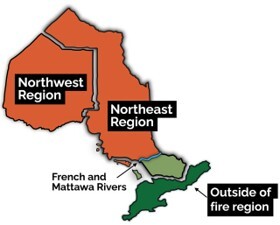
Ontario Fire Region

Ontario Regulations were amended to include electrical power generation and utilities. [vii]

Companies operating in Ontario's Fire Region (right) are required to review their operations for fire risk and have fire prevention plans, training, and equipment in place.

Fire season usually runs from April to October and peaks from May to August. To be prepared, your best protection against loss, damage or injury is prevention and mitigation. The primary focus needs to be on vegetation management, employee training, and swift incident response practices. Wildfires will always happen, and it is part of our lives. Identifying best practices and investing in ways to reduce risk are essential to managing the risks wildland fires pose better.

Ontario Fire Region Image: Source: https://www.ontario.ca/page/forest-wildland-and-outdoor-fires

square-sunburstSummer Students & Interns – Insurance Considerations

With summer vacations underway, many organizations are welcoming students through internships, co-op placements, apprenticeships, and other seasonal opportunities. These arrangements can raise important questions about liability, vehicle use, and whether coverage is available under your MEARIE insurance program.

Because student roles can vary, the insurance considerations may depend on the nature of the placement and the duties being performed. Key questions to consider include:

    • Is the individual a high school student?

    • Is the individual a college or university student?

    • Are they participating in a cooperative education, learning, job-shadowing, or similar placement program?

    • Will they be operating company equipment or vehicles?

Learn more about what this can mean for you as you take that step to being an industry leader for future generations.

square-summer-festivalsCommunity Events & Festivals – Managing Public-Facing Risk for LDCs

Participation in local summer festivals and community events is an important opportunity for LDCs to strengthen public engagement and visibility. However, these events introduce distinct public-facing risks, including liability exposure, safety hazards, and operational challenges.

Public-sector guidance consistently highlights that festivals—while valuable for community connection—require structured planning, defined responsibilities, and strong safety controls to manage risk effectively.

LDC’s often offer bucket truck lifts as a part of these events. These rides should only be offered where the following controls are in place:

    • Operation within a controlled environment by trained operators, ensuring participants are secured with approved fall‑protection and equipment is used in accordance with manufacturer and OH&S requirements. [viii]
    • Access restricted to a designated, barricaded area with defined loading/unloading procedures, continuous supervision, and emergency stop capability.
    • Established emergency communication protocols, including two‑way communication with ground personnel and clear incident response procedures.

Other key Risk Exposures to consider:

  • Public interaction with booths, equipment, or demonstrations
  • Temporary electrical infrastructure (generators, panels, cabling)
  • Third-party vendors and shared spaces
  • Large crowds and high visibility
  • Use of seasonal or temporary staff

Risk Management Checklist

Planning & Governance

Define your role (sponsor, participant, power provider) and associated responsibilities

Establish a clear event lead and internal accountability structure

Coordinate with event organizers, municipalities, and emergency services

Document an event-specific safety and response plan

Site Safety & Operations

Conduct pre-event site inspection (trip hazards, cabling, access/egress)

Ensure safe setup of temporary power sources and connections

Clearly secure and label energized equipment and restricted areas

Maintain safe distances between the public and electrical assets

Perform ongoing safety checks during the event

Staffing & Training

Train all staff and summer students on roles, hazards, and escalation procedures

Provide clear instructions for interacting with the public safely

Hold pre-event briefings and daily check-ins (if multi-day event)

Third-Party & Vendor Risk

Confirm event organizer responsibilities and controls

Review vendor setups near electrical infrastructure

Ensure coordination for shared power sources

Insurance & Risk Transfer Considerations

Confirm general liability coverage applies to event participation

Obtain and review certificates of insurance from event organizers/vendors

Ensure additional insured status where required

Clarify contractual responsibilities (indemnity / hold harmless agreements)

Consider event-specific risks (crowds, equipment, demonstrations, weather) [ix]


Read this article from the Municipal Research and Services Center (MRSC) for further information on public festivals. [x]

References

[i] Lehmann, Heidi E. (September 1, 2021). Risk Management Magazine - Protecting workers in extreme heat. Retrieved June 22, 2022, from https://www.rmmagazine.com/articles/article/2021/09/01/protecting-workers-in-extreme-heat

[ii] Workplace Safety & Prevention Services. (2026, May 1). Heat stress: What the law says and 5 ways to protect workers. Workplace Safety & Prevention Services. https://www.wsps.ca/resource-hub/articles/5-ways-to-prevent-heat-stress

[iii] Occupational Health Clinics for Ontario Workers. (n.d.). Heat stress calculator. OHCOW. https://www.ohcow.on.ca/resources/apps-tools-calculators/heat-stress-calculator/

[iv] FireSmart Canada. (n.d.). FireSmart guide to reducing wildfire risk.

[v] Government of Ontario. (n.d.). FireSmart: Protect your home and property from wildfire.

[vi] Institute for Catastrophic Loss Reduction. (n.d.). Wildfire catastrophe modeling: Analytics for a new peak peril. ICLR. https://www.iclr.org/workshop/wildfire-catastrophe-modeling-analytics-for-a-new-peak-peril/

[iv] Ontario Regulation 43/26. (2026). Wildland Fire Management Regulation, under the Forest Fires Prevention Act, R.S.O. 1990, c. F.24. Government of Ontario. https://www.ontario.ca/laws/regulation/r26043

[viii] Canadian Standards Association. (2020). CSA C225:20 (R2025) Vehicle-mounted aerial devices. CSA Group.

[ix] Government of Ontario. (2022). Temporary performance/event structures: Safety guidelines for the live performance industry. Ontario Ministry of Labour, Immigration, Training and Skills Development. https://www.ontario.ca/document/safety-guidelines-live-performance-industry/temporary-performanceevent-structures 

[x] Gallagher, L. (2023, April 17). Summer festivals and risk management. Municipal Research and Services Center (MRSC). https://mrsc.org/stay-informed/mrsc-insight/april-2023/summer-festivals-and-risk-management

Learn more about MEARIE products & services

Contact us today and a member of our team will reach out.

Request a Quote